
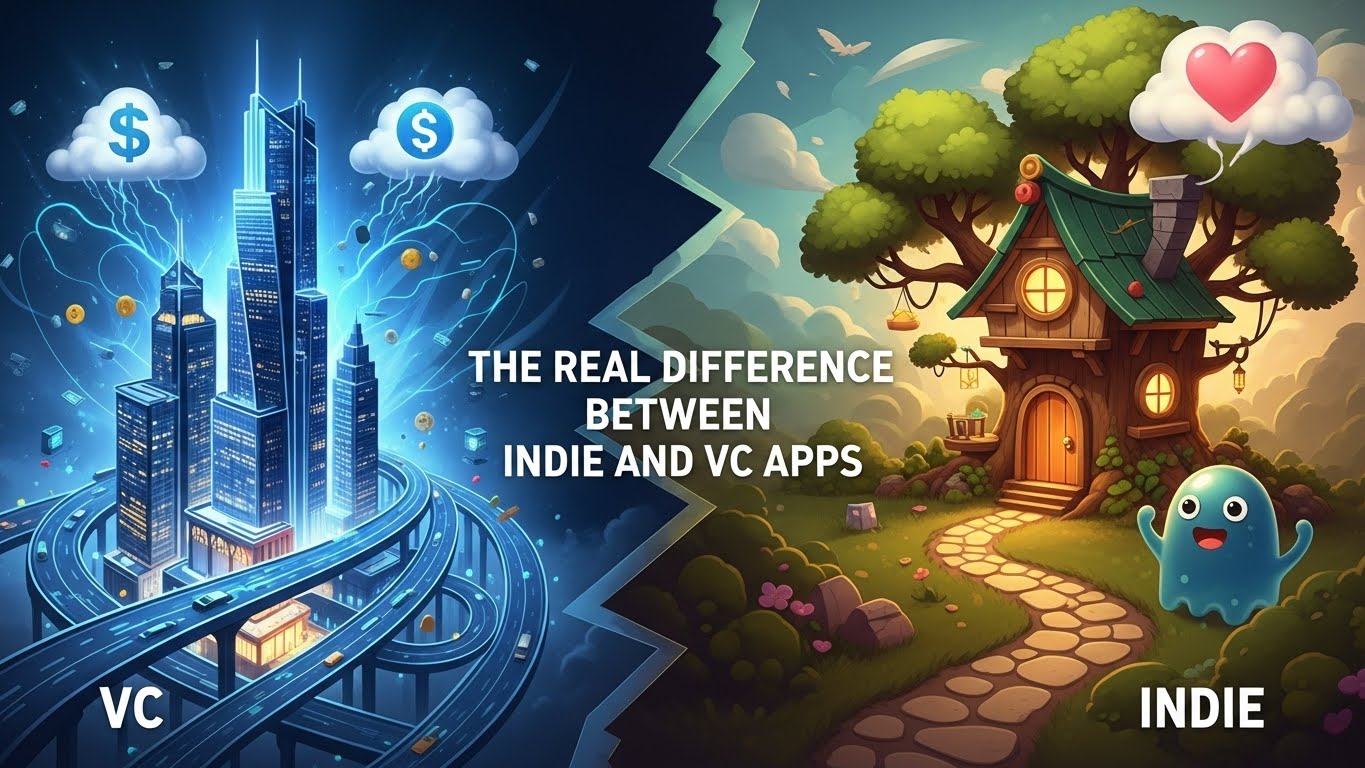
It isn’t “big vs small.” It’s “which game are you playing?” Indie and VC apps operate under different goals and constraints. When you internalize those differences, your roadmap, distribution, and daily work stop fighting each other.
The Operating Assumptions (and why they matter)
- Goal
- Indie: sustainable profit and autonomy; a product you can maintain with energy.
- VC: category leadership and growth multiples; returns that justify the fund.
- Constraint
- Indie: limited time, cash, and support capacity; every feature must pay rent.
- VC: runway, board expectations, hiring scale; can trade craft for coverage.
- Customer
- Indie: a narrow persona with a specific job; personal support and fast fixes.
- VC: multiple segments including enterprise; account management and SLAs.
These assumptions should set the bar for scope, polish, and pace.
Distribution: Two Very Different Machines
- Indie distribution
- Owned channels you control (newsletter, blog, YouTube)
- Problem pages and comparison posts that match real searches
- Integrations and marketplaces that borrow existing traffic
- Weekly artifacts: 60–90s clips, human changelogs, templates
- VC distribution
- Paid acquisition and brand campaigns
- Sales motion: demos, proof assets, case studies, ROI decks
- Partnerships and PR; wide surface area, long cycles
Go deeper: Why indie apps fail without distribution
Product: Craft vs Coverage
- Indie craft
- Opinionated scope with one crystal‑clear “aha” moment
- Reliability over breadth; ruthless descoping; simpler onboarding
- Fast iteration tied to user outcomes; human “What’s New” copy
- VC coverage
- Platform breadth, deep integrations, enterprise features
- Roadmap scale with team orchestration and governance
- Polished onboarding (ideally) but often delayed by complexity
Pricing and Packaging
- Indie
- Transparent pricing, usage gates, simple tiers, quick payback
- Freemium or trials that let users feel the core value fast
- VC
- Negotiated contracts, seats/add‑ons, annual agreements
- Proof‑of‑value and ROI tools; procurement and legal cycles
Where Founders Go Wrong
- Indie copying VC
- Feature sprawl → slow support → declining reliability
- Paid ads before activation/retention are money sinks
- Enterprise promises without delivery mechanisms
- VC copying Indie
- Under‑investing in onboarding and polish
- Ignoring niche communities that create durable advocates
- Shipping quietly without repeated storytelling
Go deeper: What founders get wrong about app reviews
Two Operating Systems You Can Adopt
- Indie OS (weekly)
- Ship one story (feature/integration/case study)
- Publish one durable asset (problem/comparison)
- Record one short demo clip (60–90s)
- Do one outreach thread (partner/community)
- Review one metric (trials → activation → retention)
- VC OS (monthly/quarterly)
- Plan cross‑functional releases with owners
- Produce sales enablement (decks, demos, proof assets)
- Run paid channel experiments and cohort analysis
- Build support runbooks (SLAs, incidents)
Decision Framework (Pick Your Game)
Ask and answer honestly:
- What do you want your day to look like for the next year?
- Which job can you be the best at for a specific audience?
- Which constraints can you hold without resentment (time, money, support)?
Your answers choose the game. Stop blending the rules.
Concrete Moves (Do These Next)
- If indie
- Define the “aha” and cut steps until it’s under 3 minutes
- Integrate with one ecosystem and publish a listing
- Write one problem page and one comparison page this month
- Prompt for ratings at success moments; reply to every 1–3★
- If VC
- Fund onboarding and polish early; measure activation properly
- Build proof assets (case studies, ROI calculators, demos)
- Staff customer success; define SLAs and incident playbooks
- Treat paid as experiments with success metrics and cohort tracking
The Human Difference
- Indie founders win on trust and responsiveness; your name is on the door.
- VC teams win on breadth and reliability at scale; your logo is in the deck.
Choose the posture that lets you show up consistently.
Related Reads
- Why indie apps fail without distribution
- What founders get wrong about app reviews
- Why App Store discovery is broken
Final Thought
Neither path is “better.” They’re different games. Pick the constraints you can love, the audience you can serve with energy, and the cadence you can sustain. Then commit, fully. The right rules make the right wins inevitable.
Leave a Reply
You must be logged in to post a comment.