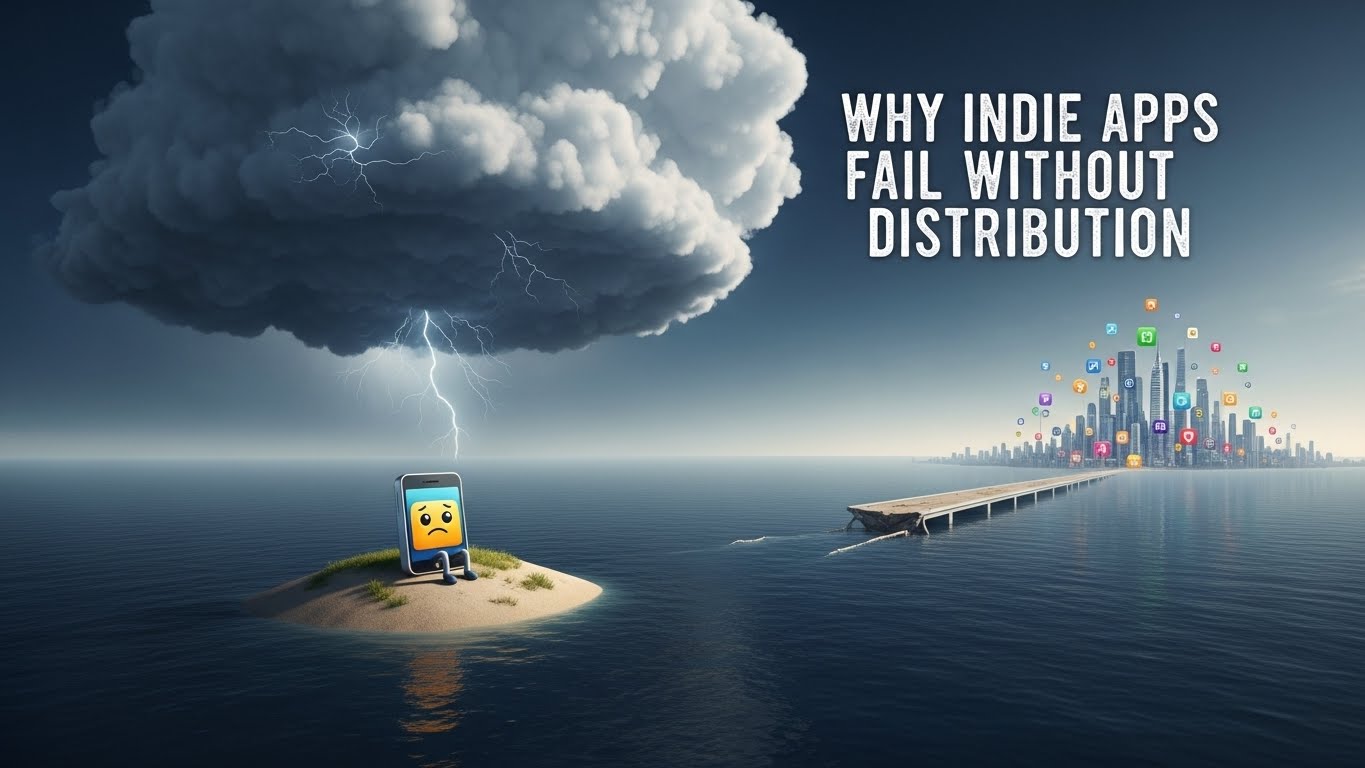
You’re not competing with other indie devs. You’re competing with attention. Most apps don’t fail because they’re bad; they fail because nobody ever consistently puts them in front of people who might care. Distribution is not a single channel you “turn on.” It’s a repeatable system for getting your product seen, understood, tried, and remembered—every week.
Below is a practical, technical playbook for indie app builders and SaaS founders who want distribution that compounds.
The Myths That Quietly Kill Good Apps
- “If it’s great, it markets itself.” Only products used in highly networked contexts “self-market.” Most indie tools are quiet by default.
- “I’ll add marketing after launch.” Distribution is an input to product decisions, not a postscript. Without early audience feedback, you build the wrong edges.
- “I need a viral hook.” You need consistency, not virality. Small, repeated impressions beat a one-time spike.
- “More features will fix it.” Shipping without telling a growing audience what changed is indistinguishable from not shipping.
A Simple Distribution Model
Think in five stages and map assets to each:
- Attention: Get a relevant person to notice you.
- Interest: Make them believe your category matters now.
- Trust: Prove you’re credible and will keep showing up.
- Trial: Lower friction to the first meaningful success.
- Habit: Nudge until your app becomes default for a job.
For each stage, define one primary channel and a cadence. Over time, make the loop tighter: ship → story → distribution → feedback → roadmap.
Owned Channels That Compound
Owned channels are the backbone: you control reach and timing.
- Newsletter: Weekly is ideal. Teach the job-to-be-done, share small wins, ask one question. Use clear CTAs back to a feature, demo, or trial.
- Blog: Write durable assets—problem pages, comparisons, deep dives, postmortems, monthly changelogs. One solid post can drive qualified traffic for years.
- YouTube or short clips: Demo the product in real workflows. Show your screen. 2–5 minutes beats polished 20-minute lectures.
Cadence beats volume. Pick one primary owned channel and commit for 12 weeks. Repurpose everything else from there.
Earned Channels Without the Spam
Earned channels amplify when you’re helpful, specific, and consistent:
- Communities: Answer questions with working steps. Record a quick Loom showing the exact fix using your app. Never link-drop without context.
- Reddit/Hacker News: “Show HN” and “Launch HN” work when the title communicates a benefit and the post is transparent about trade-offs and pricing.
- Product Hunt: Treat as a checkpoint, not a finish line. Ship a PH-sized release every 2–3 months; each one should anchor a story: what changed and why it matters now.
Principle: Solve a visible problem in public, then mention your tool as the maintained version of that solution.
Borrowed Distribution: Integrations and Marketplaces
Integrations let you stand in front of someone else’s traffic:
- Pick ecosystems with distribution: Slack, Notion, GitHub, Linear, Shopify, Airtable, Figma, Apple App Store/Mac App Store.
- Ship the integration and the listing: clean screenshots, a three-sentence value proposition, setup instructions, and a short changelog.
- Co-marketing: Offer a 2-minute co-demo to partner newsletters. Provide copy, assets, and a unique URL so they can attribute clicks.
- “Powered by” and sharable outputs: Expose templates, embeds, or public pages with lightweight branding and a link back to your site.
Technical tip: Add a first-party UTM parameter per integration source to measure which marketplace actually moves trials.
Search Discovery That Isn’t Boring SEO
People search when they’re ready to act. Your job is to be there with the right angle:
- Problem-first pages: “Sync Apple Calendar to Notion” or “Generate changelogs from git commits.” Don’t bury the how-to.
- Comparison pages: “Notion vs Evernote for technical notes,” “Raycast vs Alfred for devs,” “YourApp vs Spreadsheet.” Be honest; link to competitors.
- Alternative pages: “Best alternatives to X for Y.” If you’re not on this page, a competitor will put you there.
- Feature pages: One page per major capability, with GIFs and code/CLI snippets if relevant.
- Programmatic SEO: If your app produces artifacts (dashboards, snippets, templates), generate indexable landing pages with unique value and light personalization. Quality over spam.
Measure impressions → clicks → trials from search. Update winners quarterly, prune losers.
Social Without Burnout: The Clip Factory
Turn shipping into shareable artifacts:
- Every feature → a 30–90 second screen recording: before/after, one sentence of context, one sentence of impact.
- Every bug fix → a short thread: problem, fix, test, lesson.
- Every customer story → three beats: job, friction, outcome.
Process, not perfection: batch record on one day, schedule across the week. Always lead viewers to a durable asset (post, doc, template) they can reference later.
App Store Mechanics (iOS/macOS)
If you’re on Apple platforms, distribution is a product surface area:
- ASO: Title with primary job, subtitle with benefit. First two screenshots should tell the story without reading. Use captions.
- Update cadence: Weekly or biweekly updates keep you fresh in store rankings. Every update includes a human changelog.
- Trials and pricing clarity: Use consistent language between your site and App Store. Don’t surprise users.
- Ratings: Ask after a clear “success” moment, never on first launch. One well-placed prompt outperforms constant nagging.
- Promo codes and family sharing: Seed early users who create social proof.
Treat store listing as a landing page you A/B test through iteration.
Product-Led Growth: Activation First
A trial without activation is wasted attention. Build to the first win:
- Define the “aha” action: the smallest behavior that predicts retention (e.g., “created first automated rule,” “shared first doc,” “scheduled first recurring job”).
- Instrument events: first_open, signup, first_project, aha_action, invite_sent, subscription_started. Track activation rate weekly.
- Progressive onboarding: Hide advanced knobs until users need them. Provide prefilled examples and one-click templates.
- Embedded guidance: Inline hints, empty-state checklists, and command palettes are distribution multipliers because they reduce drop-off.
Goal: Time-to-aha under 3 minutes. If it’s longer, cut steps or add a preconfigured workspace.
Pricing and Packaging as Distribution
Pricing can either widen the top of the funnel or choke it:
- Freemium vs trial: Freemium grows word-of-mouth for collaborative tools or utilities; time-limited trials work for solo power tools with clear ROI.
- Usage gates: Gate by projects, automations, collaborators, or data volume—not by core value. Let users feel the magic before choosing.
- Team plan: Collaboration is a distribution loop. If the app works better with others, add invites early and make shared artifacts public-by-default with sensible privacy.
- Lead magnets: Free companion tools (CLI, VS Code extension, template gallery) are portable distribution nodes.
Package outcomes, not features. The more obvious your tiers are by job-to-be-done, the easier it is for others to recommend you correctly.
Instrumentation: Know What Actually Moves
You can’t improve what you don’t instrument. Minimal, useful metrics:
- Acquisition: source, campaign, first_page, first_referrer.
- Activation: time-to-aha, activation rate (aha_users / signups), drop-off steps.
- Engagement: WAU/MAU, feature adoption curves, command usage, median session length.
- Revenue: trial-to-paid, MRR, ARPU, churn, payback period, LTV/CAC.
- Retention: 4-week cohort retention by acquisition source; a bad cohort is a channel problem or a positioning problem.
Set up lightweight event tracking (PostHog, Plausible, or simple server logs). Review in a weekly ritual. Kill channels that don’t move activation or retention.
Create a weekly operating system:
- Monday: Plan the one story for the week (new feature, integration, case study). Draft outline + assets needed.
- Tuesday–Wednesday: Build and capture artifacts (GIFs, clips, screenshots, template links).
- Thursday: Publish the anchor asset (blog/video), then repurpose: newsletter, short posts, community replies.
- Friday: Outreach: DM partners, pitch a 10-minute co-demo, submit to a relevant community roundup. Close the loop on support threads with the new feature.
Track one North Star (e.g., new trials or email subscribers). If it isn’t moving after two weeks, change the story—not just the channel.
Repeated Launches Beat One Big Launch
Think in seasons:
- Minor launches: every 1–2 weeks (feature drops, integrations, templates, performance wins).
- Major launches: every 2–3 months (new platform, pricing, or a flagship capability) with a Product Hunt post and partner amplification.
- Seasonal recaps: quarterly “What we shipped + what’s next” to reset attention.
Each launch gets a landing page and a shareable demo. Measure signups within 7 days of each launch to compare apples to apples.
Two Mini Case Studies
- The Integration Multiplier A solo founder built a tiny “Linear to Notion roadmap sync.” Instead of writing one blog post, they:
- Shipped a tight Linear integration with a searchable listing
- Published “Linear → Notion sync in 3 minutes” with a 70-second clip
- Wrote two problem pages: “Share roadmaps without adding seats” and “Keep engineering and operations in sync”
- Offered a prebuilt Notion template with a “powered by” footer Result: 70% of new trials came from the integration listing and template traffic. Churn was low because setup met the aha moment in under 2 minutes.
- The Content Engine for a Utility A macOS developer shipped a screenshot utility competing with bigger names. They won by:
- Posting weekly “How I work” clips showing real workflows (bug reporting, design reviews, docs)
- Turning changelogs into stories (“I rewrote the capture pipeline—here’s the before/after speed chart”)
- Publishing “X vs Y” pages: “CleanShot vs YourApp for developers,” highlighting specific dev needs (copy-as-markdown, image diff)
- Asking for ratings only after a successful capture + copy action Result: Slow, steady compounding traffic and enough word-of-mouth among developers to sustain growth without paid ads.
Common Pitfalls (and Fixes)
- Too many channels: Pick one owned, one earned, one borrowed. Execute for 12 weeks before adding more.
- Vanity metrics: Followers without activation are noise. Optimize for trials, activation, and 4-week retention.
- Over-polish: Perfect videos posted once a quarter underperform scrappy weekly clips that teach something real.
- Hidden pricing: If people need to book a demo to know the cost, you lose indie buyers. Be upfront.
- No clear story: “Faster, better” means nothing. Name the friction you remove and show exactly how.
Technical Growth Loops You Can Build In
- Shareable outputs: Public pages with your branding (reports, docs, dashboards, templates) create organic backlinks and referrals.
- Templates gallery: Curated starting points mapped to niche workflows (QA triage, release notes, design handoff). Each template is a landing page.
- Importers: The easiest growth is helping users leave something worse. One-click import from competitor formats earns goodwill—and traffic from those queries.
- Embeds and widgets: Lightweight embeds for blogs/docs with a “Try this in YourApp” CTA.
- Command palette or CLI: Makes demos easy and increases the odds your tool gets featured in dev-centric content.
A Practical 30‑Day Distribution Plan
Week 1
- Define the aha moment and instrument it.
- Pick one owned channel (newsletter or blog) and one borrowed channel (integration listing) to focus on.
- Write: Problem page #1 and a setup guide for your fastest path to value.
- Record: A 60–90 second demo of first-run setup.
Week 2
- Ship: An integration or template with a listing page.
- Publish: Comparison page (“YourApp vs Spreadsheet for X”).
- Outreach: Offer a co-demo to one partner newsletter and one community moderator.
- Measure: Activation rate; shorten steps if time-to-aha > 3 minutes.
Week 3
- Publish: Case study #1 (tiny but real outcome; include numbers).
- Social: 3 short clips repurposed from the case study and your changelog.
- Improve: App Store listing or SEO internal linking.
- Ask: Ratings/reviews after a success moment.
Week 4
- Launch: Minor feature + Product Hunt mini-release or Show HN.
- Publish: Problem page #2 and a monthly “What we shipped.”
- Retention: Add one in-app checklist to guide new users to the aha action.
- Review: Trials, activation, retention by channel. Kill one thing, double down on one thing.
Checklists You Can Steal
Pre‑Launch
- Clear headline: who it’s for, one sentence job-to-be-done
- One-click template or demo data
- Instrument events and funnels
- Pricing page with a simple tier matrix
- Integration scope for your first listing
Launch Week
- Anchor article or video
- Problem page + comparison page live
- 3 short clips scheduled
- Product Hunt listing prepared with real screenshots
- Partner email template and UTM links
First 30 Days
- Two minor releases, each with a story
- One case study and one template published
- Ratings prompt wired to success moment
- Cohort report for week 0–4 retention
Ongoing
- Weekly ritual maintained
- One integration or template per month
- Quarterly recap + roadmap peek
- Prune content that doesn’t convert
Why Indie Apps Fail Without Distribution — Newsletter Cut
Most indie apps don’t lose to competitors; they lose to obscurity. Distribution isn’t a stunt you do on launch day—it’s the weekly system that makes the right people see, try, and remember your product.
Here are five moves to run for the next 30 days:
- Pick one owned channel and show up weekly
- Options: newsletter, blog, YouTube short demos
- Format: one story (feature, integration, or case study), one lesson, one CTA
- Ship one integration or template with a listing
- Ecosystems with built‑in traffic: Notion, Linear, GitHub, Slack, App Store
- Add clean listing assets + a short changelog
- Make two SEO pages that match real searches
- One problem page (e.g., “Generate changelogs from git commits”)
- One comparison page (e.g., “Raycast vs Alfred for devs”)
- Cut time‑to‑aha under 3 minutes
- Prefill demo data or add a one‑click template
- Instrument: signup → aha_action → invite → subscription
- Turn shipping into clips
- Record a 60–90s screen demo for every release
- Post with a single outcome: who it helps and how fast
Track one number: weekly activations (users who hit your aha action). If it’s flat for two weeks, change the story, not just the channel.
CTA: Want the full playbook + templates? Read the longform guide: “Why Indie Apps Fail Without Distribution.”
Why Indie Apps Fail — 5 Social Clip Scripts
Clip 1 — The Real Competition (45–60s) Hook: Your indie app isn’t competing with other apps. It’s competing with attention. Beats:
- Most apps don’t fail because they’re bad—they fail because no one sees them
- Distribution = weekly system: ship → story → publish → feedback → roadmap
- CTA: Pick one channel and commit for 4 weeks
Clip 2 — Aha in 3 Minutes (45–60s) Hook: If your trial can’t reach “aha” in under 3 minutes, you don’t have a distribution problem—you have activation debt. Beats:
- Define the aha event
- Prefill demo data or one‑click template
- Measure activation rate weekly
- CTA: Wire the event and check it Friday
Clip 3 — Borrowed Distribution (45–60s) Hook: Integrations are distribution. Get in front of existing traffic. Beats:
- Choose ecosystems: Notion, Linear, GitHub, Slack, App Store
- Ship the listing with clean screenshots and a sharp value line
- Add UTM per ecosystem
- CTA: One integration this month
Clip 4 — Content Without Burnout (45–60s) Hook: Turn every release into a clip. Perfection loses to cadence. Beats:
- Record 60–90s before/after demos
- One sentence of context, one sentence of impact
- Drive to a durable asset (post, doc, template)
- CTA: Batch record on Tuesdays
Clip 5 — The Scorecard (45–60s) Hook: Don’t guess—audit your distribution in 60 seconds. Beats:
- Owned channel weekly? Borrowed channel live? Problem + comparison page?
- Time‑to‑aha ≤ 3 min? Ratings at success moment? Weekly review?
- Aim for 12+ points
- CTA: Fix the lowest score this week
Final Thought
If you can’t reliably generate attention, features won’t save you. Distribution is a system, not a stunt. Treat it like code: design it, instrument it, schedule it, and refactor it. Pick a few channels, show up weekly with real, specific help, and make it easier—every sprint—for a new user to reach the moment your app clicks. Do that for a quarter and you’ll stop wondering where users come from. You’ll know, because you shipped the system that brings them.